
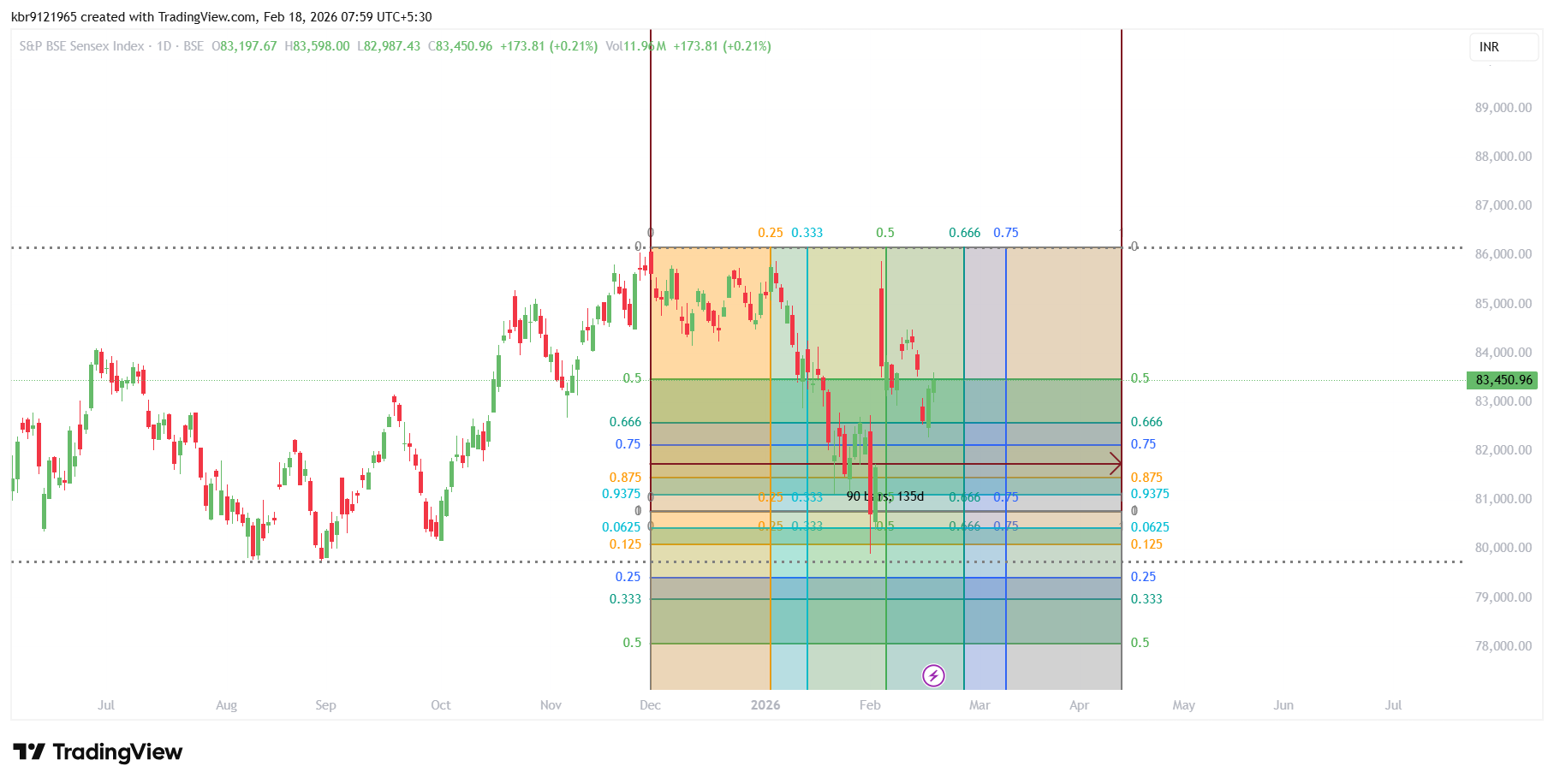
The S&P BSE Sensex closed at 83,450.96 on February 17, 2026, marking a modest gain of 173.81 points (+0.21%) in a session that saw the benchmark index trade between a low of 82,987.43 and a high of 83,598.00. Volume stood at around 11.96 million, reflecting steady participation amid mixed global cues and ongoing domestic earnings momentum.
This snapshot from TradingView highlights the index hovering near recent consolidation levels after peaking at an all-time high of 86,159.02 in December 2025. The chart reveals a clear uptrend from mid-2025 lows, with the current price sitting roughly 3-4% below that record, suggesting a healthy pullback phase rather than a reversal.
Key Technical Observations
The chart incorporates Fibonacci retracement levels drawn from a prior swing (likely from late-2025 highs to a corrective low), with prominent zones. We learn this on short term basis in our Gann Intraday Trading Course, and on long term basis in our Gann Price Cycle Course and Gann Time Cycle Course. The details zone analysis is
- 0.875 (around 81,000–82,000 range, marked with an arrow indicating potential resistance or extension target)
- 0.75, 0.666, 0.5, 0.333, and 0.25 acting as support/resistance bands
- Price action recently bounced from near the 0.5–0.666 confluence zones, with candles showing rejection at higher levels and support holding around 83,000.
The index is currently testing the upper end of a consolidation band (green/yellow zones), with momentum indicators appearing neutral to mildly positive. A breakout above 83,600–84,000 could target the previous highs near 86,000, while failure to hold 83,000 might see retests of lower Fibonacci bands around 82,000 or 81,000.
Recent Market Drivers
Tuesday’s session (February 17) saw gains driven by strength in IT (e.g., Infosys rallying on its AI partnership with Anthropic), FMCG (ITC up notably), and select blue-chips like Larsen & Toubro, Asian Paints, and Adani Ports. Offsetting this were drags from energy, metals, and heavyweight Reliance Industries.
Broader context:
- The index has risen ~9.85% year-over-year but only ~0.25% over the past month, indicating a consolidation phase after 2025’s strong run.
- Nifty 50 mirrored the move, closing at 25,725.40 (+0.17%).
- India VIX eased, signaling reduced near-term fear.
Analysts note stabilizing corporate earnings, signs of consumption revival, and positive fiscal/monetary tailwinds. Upcoming events like trade deal progress (e.g., with the US and EU) and the ongoing India AI Impact Summit are supporting sentiment in tech and innovation-driven sectors.
Outlook for 2026
The Indian market enters 2026 with structural tailwinds: robust GDP growth expectations, increasing domestic equity participation, improving macros, and potential policy support. Brokerages remain largely optimistic:
- Bullish scenarios project Sensex targets of 95,000–107,000 by year-end (e.g., Morgan Stanley’s bull case).
- Base cases hover around mid-90,000s.
- Risks include global trade uncertainties, elevated valuations in some pockets, and potential mean reversion after a decade-long winning streak (Sensex posted positive annual returns for 10 straight years through 2025).
Short-term, the market appears poised for range-bound trading with a positive bias if 83,500–84,000 holds. A decisive move higher could reignite momentum toward retesting all-time highs, while downside protection sits at recent swing lows.
For investors, this phase underscores patience: focus on quality large-caps, diversified exposure, and sectors benefiting from AI, infrastructure, and consumption recovery. The long-term India growth story remains intact, with the Sensex’s trajectory pointing toward higher levels through disciplined accumulation during consolidations.
Stay tuned for Wednesday’s open—early cues suggest a steady to mildly positive start amid supportive global equity trends.