
Sensex Intraday Vibrations: Decoding Gann’s Law of Vibration on March Expiry Day
Markets are not random. They move according to hidden rhythms — frequencies that repeat in price and time. This is the essence of Gann’s Law of Vibration, the powerful principle discovered by legendary trader W.D. Gann. He believed every stock, commodity, or index possesses its own unique “vibration” or rate of movement. Once you identify this vibration, you can pinpoint exact levels of support, resistance, tops, and bottoms long before the crowd reacts.
Yesterday’s (March 25, 2026) March weekly expiry session on the BSE Sensex offered a textbook demonstration of this law in action.
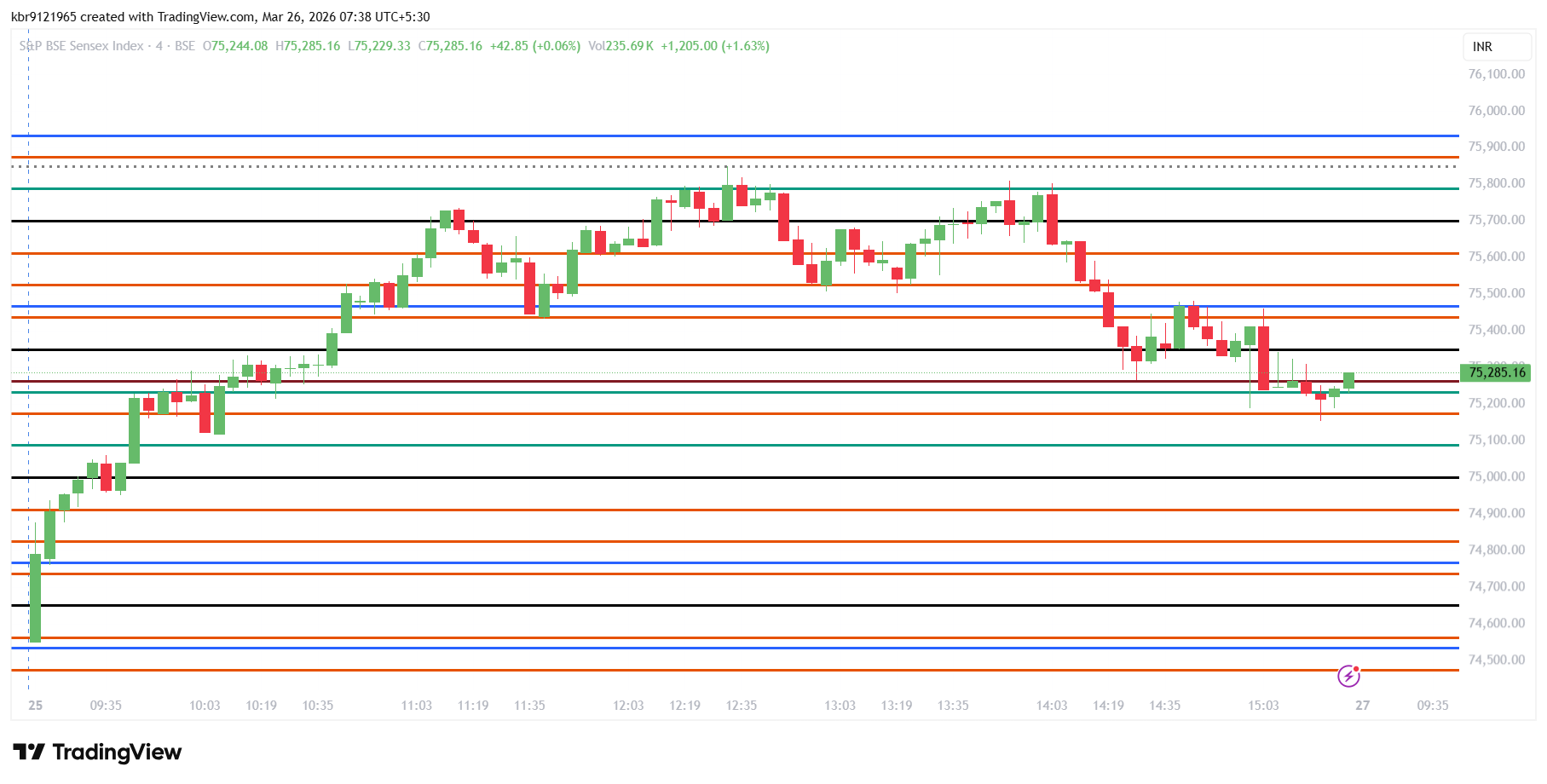
The index opened with bullish momentum and climbed steadily, registering three distinct highs that reflected shifting vibrational energy:
- Primary High: 75,849.76 at 12:31
- Secondary High: 75,809.28 at 13:51
- Tertiary High: 75,802.02 at 14:03
These progressively lower peaks signaled a classic distribution phase — where supply began overpowering demand at higher levels. By 14:03, the vibration had clearly turned. What followed was a rapid intraday fall on expiry day, with the Sensex plunging to a low of 75,153.67 at 15:19. The index eventually closed the day at 75,273.45, up 1,205 points (+1.63%), but the late-session decay and distribution told a deeper story about shifting market frequencies.
Key Vibrational Levels Post March Expiry
With today (March 26) being a trading holiday for Ram Navami, traders now have a pause to reflect on these vibrations before Friday’s session.
For the uptrend to maintain its positive frequency going forward, the Sensex needs to hold above 75,472 in the coming sessions.
Immediate Resistance Zones (where selling vibration may intensify):
- 76,050 – 76,400
- 77,100
Trend Change Confirmation Levels: A decisive crossover above 78,500 would serve as the first positive sign of a stronger upward vibration. Sustaining beyond 79,900 would then establish a fresh bullish structure capable of challenging the all-time high.
On the downside, the 75,000 psychological level remains a major support zone. A breach here could accelerate the fall toward the more critical 74,650 zone — especially significant as we move past the March expiry into the next cycle.
Short-Term Breakout and Option Chain Vibrations on Expiry
For a trend breakout, watch 75,933. A convincing move above this level could trigger short covering, putting the 76,000 PE in immediate danger. Conversely, failure to cross 75,700 convincingly keeps the 75,000 CE vulnerable to time decay, particularly after the 2 PM distribution.
Swing top confirmation would come if the Sensex stays below 75,087.50 in the sessions ahead — a clear sign that the current vibrational cycle has topped out.
Applying Gann’s Law of Vibration Practically
Gann taught that markets vibrate like everything else in nature. Highs occur when positive vibrational energy peaks; distribution follows when that energy exhausts; and sharp moves (up or down) reflect a sudden shift in frequency. By mapping these exact price-time points — the triple highs, the distribution completion at 14:03, and the rapid drop on expiry day — we align ourselves with the market’s natural rhythm rather than fighting it.
Have a great monthly expiry cycle ahead!
Whether you’re positioned long, waiting for a breakout above 75,933, or respecting the 75,000–74,650 support zone, remember: the edge comes from understanding the vibration, not predicting random noise.
Stay disciplined, respect the levels, and let the market’s own frequency guide your next move.