
The Indian stock market, particularly the S&P BSE Sensex, often exhibits intriguing cyclical patterns that seasoned traders analyze through timeless technical frameworks. One such powerful concept is Gann’s Law of Vibration, introduced by the legendary trader W.D. Gann in the early 20th century. Gann’s Law of Vibration suggests that markets, like everything in the universe, operate according to vibrational laws—where price movements follow mathematical harmonies, cycles, and specific “rates of vibration” unique to each asset or index.
Gann’s Law of Vibration posits that every stock, commodity, or index (including Sensex) has its own inherent vibration rate, influenced by internal market energies (psychology, volume, momentum) and external harmonic forces. High vibration drives strong upward trends, while disruptions or lower vibrations lead to corrections, distribution phases, or deeper declines. Gann claimed this universal law allowed precise forecasting of turning points, support/resistance, and trend shifts by treating the market as a vibrating entity governed by natural mathematical laws.
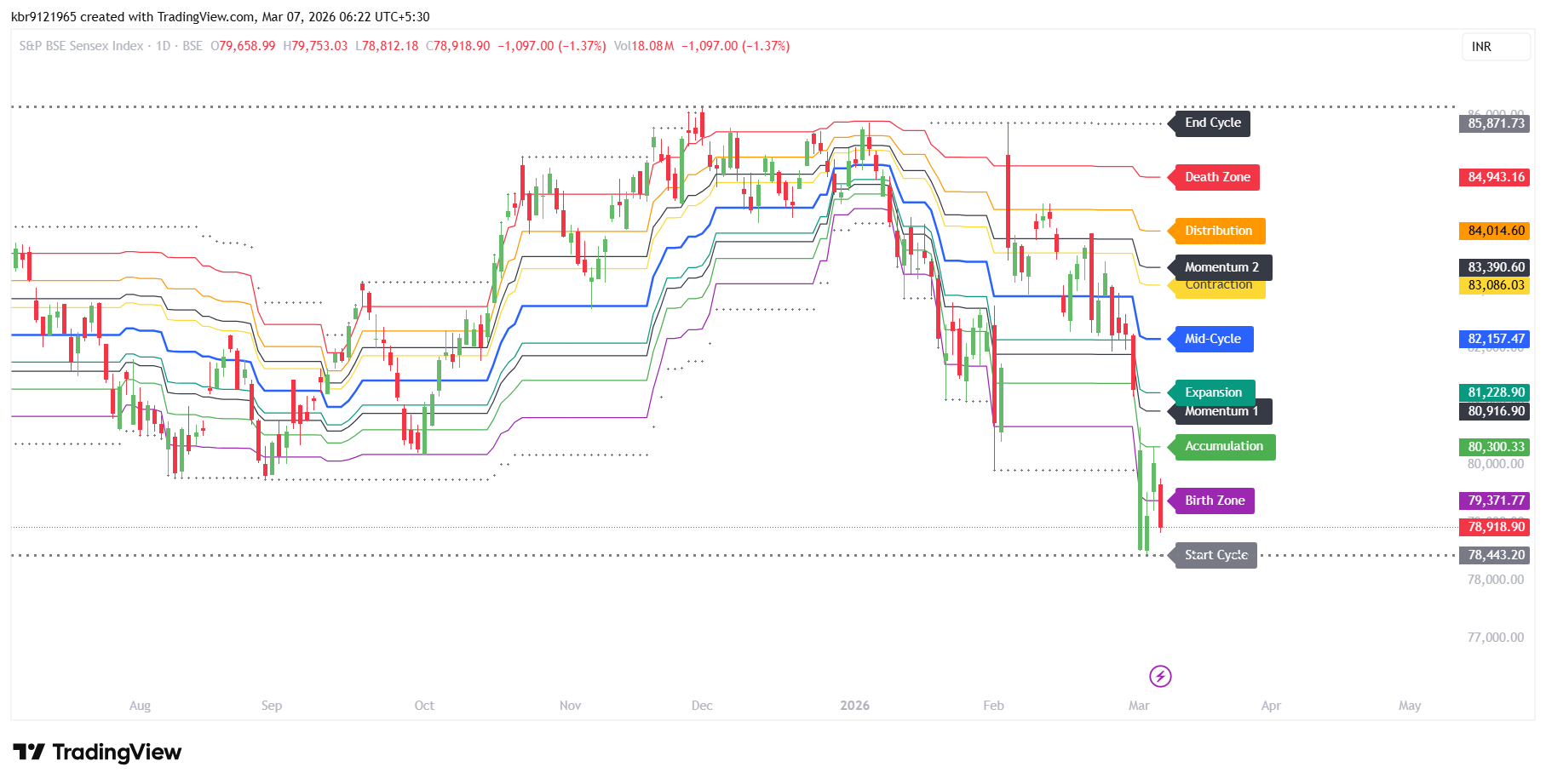
On March 7, 2026, the Sensex provides a compelling real-world example of how Gann’s Law of Vibration might manifest in practice. The index closed at approximately 78,918.90, down sharply by -1,097 points (-1.37%) on elevated volume, reflecting a significant pullback from recent highs near the upper cycle zones.
Understanding Gann’s Law of Vibration in Depth
Gann’s Law of Vibration is rooted in these core ideas:
- Everything vibrates — Stocks, indices, and commodities follow individual vibrational frequencies, much like atoms or tuning forks.
- Vibration drives price — Uptrends occur during high/positive vibration phases; downtrends or contractions signal vibration slowdowns or shifts.
- Mathematical harmony rules — Prices align with geometric angles (e.g., 45° Gann lines), squares (Square of 9), time-price squaring, and repeating cycles.
- Phases reflect vibrational states — Markets transition through Accumulation (building vibration), Expansion/Momentum (high vibration), Distribution (vibration peaking then fading), Contraction (vibration dropping), and potential Death/End zones before a reset or new Birth cycle.
Gann viewed these as universal principles — nothing escapes the law of vibration.
Applying Gann’s Law of Vibration to the Current Sensex Chart
The attached TradingView chart (daily timeframe) overlays a custom cyclical framework that aligns strikingly with phases inspired by Gann’s Law of Vibration:
- Prolonged Expansion and Momentum zones (green/black) drove Sensex upward from ~80,000 levels to peaks near 86,000 — classic high-vibration bullish phase under Gann’s Law of Vibration.
- Momentum peaks around 83,390–84,014, followed by Distribution (orange) and Death Zone (red) near 84,943–85,871 — indicating vibration reaching exhaustion and starting to decline.
- The recent sharp drop has broken into Mid-Cycle (blue), approaching Accumulation (green) near 80,300 and the pivotal Birth Zone at 79,371.77 — signaling a major vibrational downshift and potential cycle transition.
- Current close sits just above the Start Cycle baseline (~78,420–78,918), with the lower boundary marking a possible full vibration reset point.
Through the lens of Gann’s Law of Vibration, this structure shows:
- The drop below 80,916 (Momentum 1) and toward 79,371 (Birth Zone) reflects weakening upward vibration, with selling pressure dominating.
- The steep fall from upper channels (possible Gann angle equivalents) into lower harmonic levels indicates a shift from high to low vibration — a textbook correction or reversal setup.
- If the Birth Zone (~79,371) and Start Cycle (~78,420) hold, renewed positive vibration (volume surge, sentiment flip) could initiate a new upward harmonic cycle.
- A break below ~78,000 might deepen contraction, pushing toward even lower vibrational supports.
Implications for Traders in 2026 Using Gann’s Law of Vibration
Gann’s Law of Vibration isn’t about rigid predictions but attuning to harmonic patterns and cycle stages. For Sensex traders right now:
- Monitor stabilization around the Birth Zone (~79,371) and Start Cycle (~78,420) — key vibration reset areas where a new bullish phase could emerge if vibration strengthens.
- Watch overhead resistance in Distribution/Death Zones (84,000+) — reclaiming these requires a strong vibrational rebound.
- Time remains crucial — Gann emphasized time-price harmony; track cycle anniversaries or upcoming vibrational turning windows.
While no method is foolproof, Gann’s Law of Vibration reminds us markets aren’t random — they pulse according to deeper, repeating patterns. The current Sensex pullback may represent a classic vibrational transition, creating opportunities for those who study these cycles closely.
Whether you’re trading from Mumbai’s bustling markets or analyzing from anywhere, frameworks like Gann’s Law of Vibration add profound depth. Always pair with solid risk management, fundamentals, and personal validation.
What’s your take, bhai — is this a vibration reset leading to fresh upside, or more downside vibration still playing out? 📉✨ Drop your thoughts!